
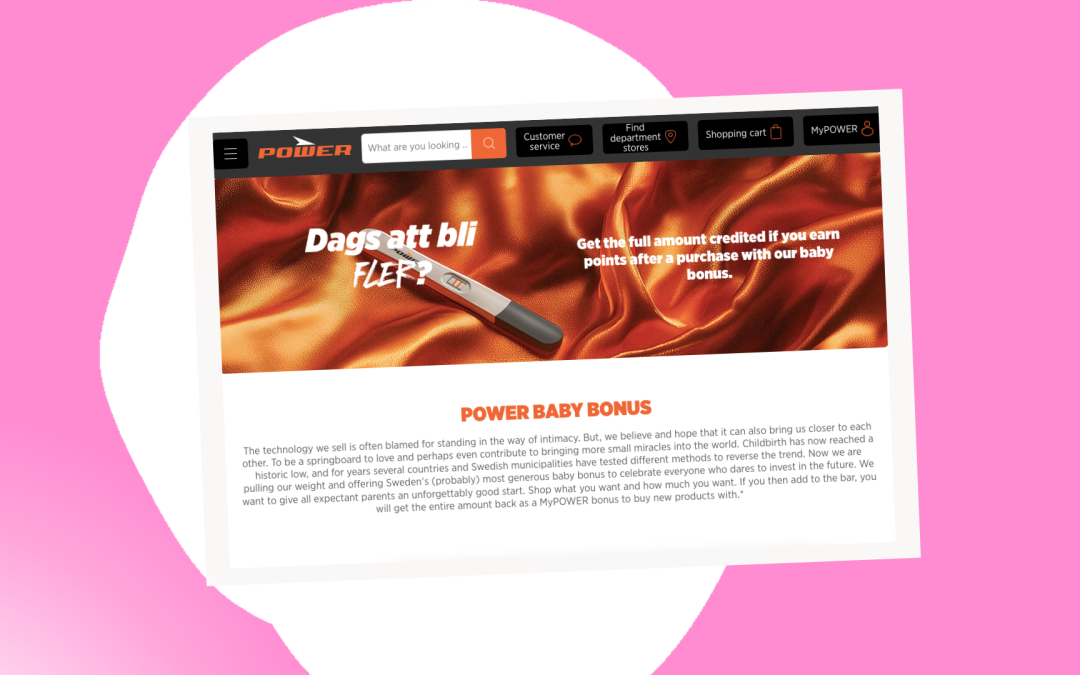
Buy a TV, get pregnant – and get your money back. This may sound like satire, but it is real. Electronics retailer Power (formerly MediaMarkt) has launched the “Baby Bonus”: if you become pregnant within 30 days of your purchase, you get a full refund in store credit. Their slogan: “Now we ensure that Sweden grows by promoting our offers.”
Meanwhile, tech figures like Elon Musk and Jeff Bezos have for years been warning Europe and North America of an alleged “population collapse.” Musk has called it civilisation’s greatest threat and has made it his personal mission to father as many children as possible.
Such statements do not come out of nowhere. They connect to right-wing populist ideas that low birth rates are a national threat, and to anti-gender rhetoric claiming that feminism, LGBTQI+ rights and critical race theory have gone ‘too far.’ At the same time, migration is rejected as a possible solution – as we saw in the conversation between Musk and the far-right nationalist AfD leader Alice Weidel.
Now we see the same logic in Swedish advertising. Power even suggested that Swedes spend more time fiddling with their phones than with each other, claiming their campaign would “give a boost to childbirth.”
This coincides with the Swedish government launching an inquiry into declining birth rates, tasked with analysing causes and proposing ways to remove obstacles to family formation.
For civil society working on gender equality, justice and a green transition, this is not just a quirky PR idea. It is part of a global pattern. Tech giants push pronatalism with arguments that closely resemble those of far-right and anti-gender movements. Companies join in as they chase growth, legitimising the idea that population decline is a “crisis” best solved by births – not by migration, redistribution or stronger care policies. The result: reproductive politics are trivialised into a consumer issue, with responsibility shifted onto individuals.
Another dimension cannot be ignored: tech billionaires like Musk and Bezos have built their fortunes on exploitation of natural resources and labour. Oxfam’s latest report shows billionaire wealth growing three times faster than the economy at large. In this light, pronatalism is not only ideology, but also a way to secure future consumers in a system that already fuels inequality and the climate crisis.
The timing is no coincidence. Pronatalist narratives gain traction as governments move resources away from welfare and climate action into militarisation. We have seen this before in Europe: in the first half of the 20th century, women were tasked with “building the nation” through childbirth. Then as now, demographic anxieties were instrumentalised to restrict reproductive rights, scapegoat migration, and advance exclusionary nationalist agendas.
If we treat declining birth rates as a crisis but ignore migration, care and redistribution, we have already chosen nationalism over justice.