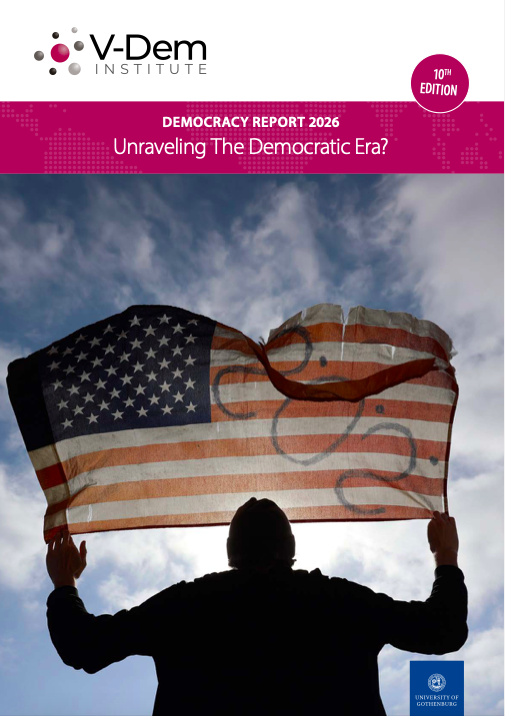
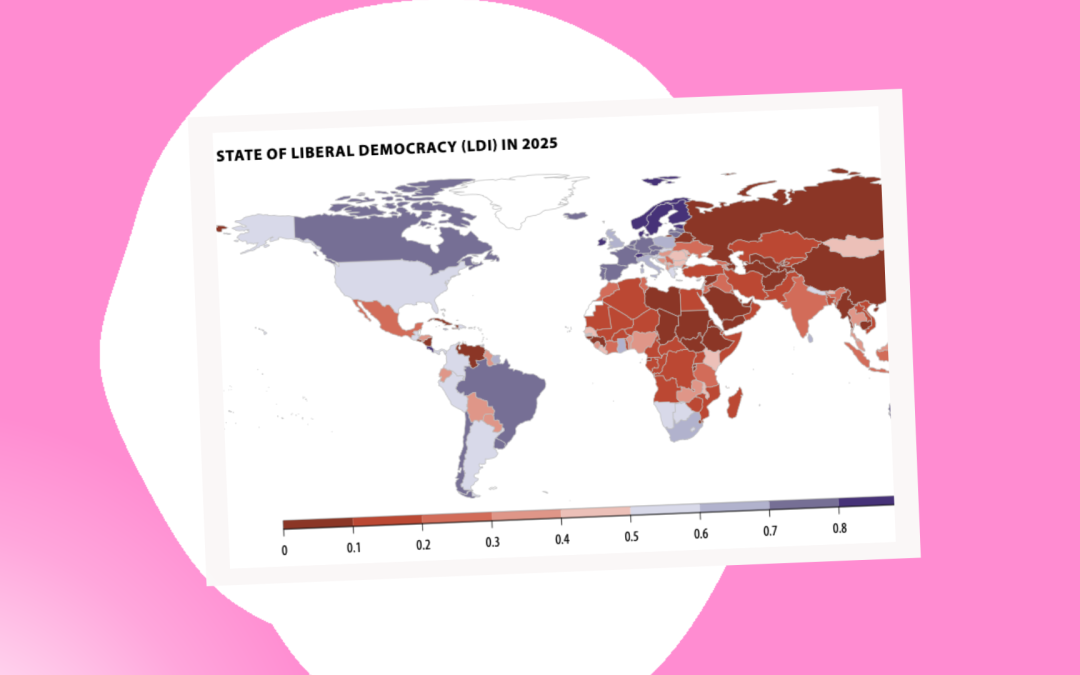
A new report from the V-Dem Institute, drawing on the expertise of more than 4,200 scholars and country experts, warns that democracy is rapidly declining across the world, including throughout the UNECE region.
According to the Democracy Report 2026, democracy for the “average global citizen” has fallen back to 1978 levels, erasing many of the gains associated with the so-called “third wave of democratization” that began in Portugal in 1974.
The report paints a particularly alarming picture for Europe and North America:
- The level of democracy in Western Europe and North America is now at its lowest level in more than 50 years.
- The United States has lost its status as a “liberal democracy” for the first time in over half a century.
- The European Union is “greatly affected” by autocratization trends, with seven EU member states identified as autocratizing, alongside the United Kingdom and the United States.
Among the newly identified autocratizing countries in Europe are Croatia, Italy, Slovakia, Slovenia, and the United Kingdom.
The report also highlights the growing use of authoritarian tactics:
- Freedom of expression is now the most attacked democratic principle globally, declining in 44 countries.
- Media censorship remains the most common tactic among autocratizing governments, used in 73% of autocratizing countries.
- Repression of civil society now affects 68% of autocratizing countries.
The report reserves particular concern for developments in the United States, warning that “the speed with which [the US] democracy is currently dismantled is unprecedented in modern history.”
Today, 74% of the world’s population lives under autocratic rule, while only 7% live in what the report classifies as “liberal democracies.”
A note on the language of “liberal democracy”
At Holding the Line, we also recognise that terms such as “liberal democracy” are not politically neutral. Many feminist, decolonial, Indigenous, anti-racist, and Global South scholars have long critiqued liberal democracy as a historically Western political model that emerged alongside colonialism, capitalism, patriarchy, and racial hierarchy.
From a decolonial perspective, democracy cannot simply be reduced to elections, institutions, or market-based governance structures. Liberal democratic systems have often coexisted with colonial violence, border regimes, extractivism, racial exclusion, militarisation, and the suppression of Indigenous sovereignty.
At the same time, the global rise of authoritarianism, anti-rights mobilisation, attacks on civil society, media censorship, and restrictions on bodily autonomy represent real and escalating threats — particularly for feminist, LGBTQI+, environmental, Indigenous, migrant, and racial justice movements.
For us, this moment requires holding two truths simultaneously:
- rejecting the myth that Western liberal democracy represents the final or universal model of justice;
- while also resisting the accelerating erosion of civic space, human rights protections, collective freedoms, and democratic participation.
As authoritarian politics deepen across the UNECE region and beyond, feminist and decolonial movements continue imagining and building “democracy otherwise”, grounded in solidarity, collective care, ecological justice, self-determination, and accountability beyond colonial systems of power.