30 Apr 2025 | 2030 Agenda, Reports & toolkits
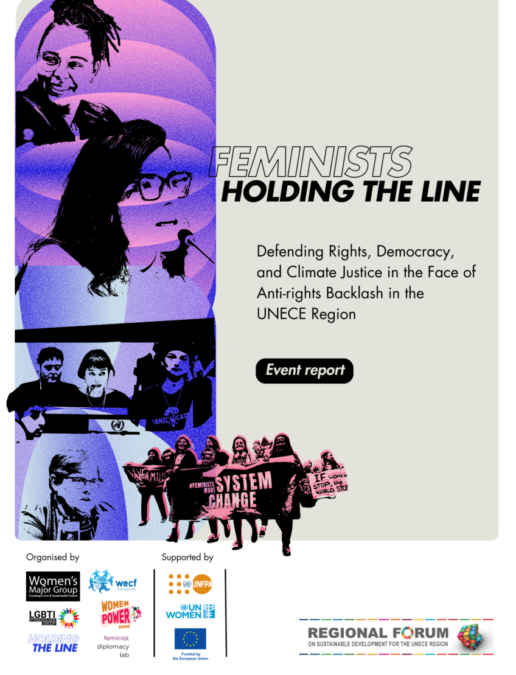
On 2 April 2025, we hosted the side event “Feminists Holding the Line: Defending Rights, Democracy, and Climate Justice in the Face of Anti-rights Backlash in the UNECE Region” at the UNECE Regional Forum on Sustainable Development.
Co-organised by Women’s Major Group, Women Engage for a Common Future (WECF), Holding the Line, LGBTI Stakeholder Group, Feminist Diplomacy Lab, WomenPower2030 (funded by European Union), UNFPA Eastern Europe and Central Asia, UN Women Europe and Central Asia, the event created an important space for reflection and strategy-building in a time of growing threats.
Our current context
The far-right, anti-gender, and anti-rights movements across the UNECE region are intensifying, threatening the fundamental rights and freedoms many have fought for over decades. From the United States’ rejection of the 2030 Agenda and gender equality commitments, to the European Union’s withdrawal of the Equal Treatment Directive, to the spread of Foreign Agent Laws in Hungary, Georgia, and beyond, the civic space for feminist and queer activism is being deliberately constrained.
Alongside political backlash, significant funding cuts from major donors including the US, Netherlands, Sweden, and the UK are severely impacting the ability of feminist and queer organisations to sustain their work. At the same time, the so-called green transition is often replicating extractive and colonial dynamics, further marginalising vulnerable communities, especially in the Global South.
The urgent need for collective action, solidarity, and new strategies could not be clearer.
Key discussion points
Moderated by Valentina Bodrug-Lungu (Gender-Centru Moldova and Women’s Major Group Organising Partner for UNECE) and Hanna Gunnarsson (Women Engage for a Common Future, Holding the Line, ECE-RCEM Governing Body), the discussion brought together activists, researchers, and experts to unpack the historical roots of today’s challenges and share ideas for resistance and transformation.
Speakers highlighted
- The coordinated rise of anti-rights movements combining anti-gender, racism, and climate denialism narratives (Aïda Yancy)
- The deep links between fossil capitalism, colonialism, and far-right ideologies (Martin Hultman)
- The power of solidarity-based coalitions and the importance of grassroots leadership (Mariam Topchishvili)
- The role of language and culture in resisting colonial legacies (Marsel Ganeyev)
- The importance of international human rights mechanisms and fostering inclusive civic spaces (Gabriela Alvarez Minte)
- The need to deconstruct patriarchal structures and cultivate new systems based on care, sustainability, and interdependence (Vidar Vetterfalk)
15 Apr 2025 | Commission on the Status of Women, Policy positions
The 69th session of the United Nations Commission on the Status of Women (CSW69) has concluded, presenting a mix of limited progress and significant setbacks. As the Holding the Line coalition, a network of feminist activists and human rights defenders from the UN ECE region, we approached this session with a clear objective: to challenge the growing attacks on gender equality, human rights, and democracy, as well as pushing for genuine progress.
One of the outcomes of CSW69 was the adoption of the Political Declaration, marking the 30th anniversary of the Beijing Platform for Action. In a global context where authoritarianism is rising, patriarchy is resurgent, funding for human rights and gender equality are slashed by the day, and anti-rights movements are gaining power exponentially, any reaffirmation of gender equality commitments is important. We acknowledge the inclusion of language on STEM, care policies, references to the ILO conventions, equal pay for work of equal value, right to work and rights at work, collective bargaining, freedom of association, conflict related sexual violence (CRSV), adolescent girls, reference to survivors, and the first ever reference to Gender-Based Violence (GBV), in this Political Declaration as significant progress. These are steps forward, though insufficient.
That being said, we cannot ignore the critical limitations of this declaration. The absence of explicit references to sexual and reproductive health and rights (SRHR) is a direct betrayal of the Beijing Platform for Action, the Cairo Plan of Action, and Agenda 2030. We have seen new Member States becoming vocal opponents of these fundamental rights and bodily autonomy. It is a clear result of the attacks we see on LGBTI+ rights, especially against trans rights, and against sex workers’ rights. This signals a dangerous retreat, empowering and emboldening those who seek to reverse hard-won gains.
The challenges of CSW69 went beyond the negotiated text. Visa denials, security concerns, and the shrinking space for civil society action, despite broad participation, showed the growing barriers to meaningful engagement. These are not merely logistical problems; they are deliberate attempts to silence marginalized voices and undermine the multilateral system.
We saw the influence of anti-rights movements, spreading misinformation and stigma, even within the UN building. The strength in resources of the anti-rights groups was visible in their numbers, and the spaces they convened to attack human rights and gender equality, including the infamous Conference on the State of Women and Family (CSW-F).
Even with these difficulties, the resolve of feminist movements was a powerful force. We, as feminists, showed the strength of collective action and our commitment to preventing regression.
The proposed revitalization of the CSW offers a chance to improve accountability, increase civil society engagement, and ensure the participation of the most marginalized. We urge member states to undertake this process with urgency, transparency, and inclusivity, making the CSW a strong platform for advancing gender equality. We add our voice to the Women’s Rights Caucus Priorities for CSW Revitalization and the Global Youth and Adolescent Recommendations fo the Revitalization of CSW.
The CSW’s Multi-Year Programme of Work, outlining themes for 2026-2029, presents both opportunities and concerns. While we acknowledge the inclusion of critical themes such as access to justice, the intersection of gender equality with the 2030 Agenda, care systems, and women in humanitarian emergencies, we must remain vigilant. It must be noted that references to human rights, while it has never been a priority theme before, were removed, a concerning move by several delegations. This is certainly a missed opportunity in the efforts to establish human rights as central to the work of the UN.
We welcome the decision to revisit the Commission’s methods of work in 2027 and the ongoing revitalization process. These processes must be transparent and inclusive, ensuring the meaningful participation of feminist civil society and marginalized voices without fear, without visa denials, without space restrictions, with the opportunity to get their voices heard.
We urge member states to prioritize accountability mechanisms and to strengthen the CSW’s capacity to monitor and advance gender equality commitments, especially in the face of growing pushback. The invitation to consider older women as a focus area is a welcome one, but all future work must strongly center intersectional feminist analysis, with a life course approach. We must ensure that the CSW remains a dynamic and responsive platform, capable of driving transformative change, rather than merely reiterating past commitments, or becoming a playground of anti-rights and anti-gender organizations and narratives, where they both work on regressing from existing commitments, as well as blocking and weakening the multilateral processes such as CSW.
With geopolitical realities shifting and a growing trend of right-wing governments coming into power, as the Member States of the Commission rotate, our strategies must keep up too. For the next two years, the United States will join the Commission as a voting member. CSW69 has already demonstrated how disruptive Members States can be to blocking consensus, rolling back progress, and derailing efforts to satisfy their own ideologies. As we reflect on CSW69 we must think ahead, strategically plan our advocacy, and despite severe pushback, keep holding the line.
As Holding the Line, we will continue our advocacy and activism in future multilateral meetings and processes, and we are committed to:
- Challenging the Far-Right: We will continue to oppose the anti-gender and anti-rights movements.
- Prioritizing Marginalized Voices: We will amplify the voices of historically excluded communities and people and defend their rights.
- Insisting on Intersectionality: We will dismantle all forms of discrimination, including xenophobia, racism, ableism, and LGBTQIA+ phobias.
- Demanding Accountability: We will hold governments and institutions responsible for their commitments to gender equality and human rights.
- Strengthening Solidarity: We will build our network, fostering new collaborations and collective action.
- Fighting for SRHR: We will continue to demand the full inclusion of Sexual and Reproductive Health and Rights in all international agreements.
- Advocating for Climate Justice: We will push for strong climate language that acknowledges the impact of harmful gender roles and breadwinner masculinities, meanwhile highlighting solutions for a feminist regenerative future.
- Reinforcing the CSW: We will continue to fight barriers for participation and advocate for the increased power and inclusion of marginalized voices within the CSW.
As we mark the 30th anniversary of the Beijing Platform for Action, we reaffirm our commitment to gender equality, women’s and girls’ autonomy, and human rights for all. We will not waver in our determination to resist, reclaim, and reshape the world based on feminist values. We will continue to demand justice and build a future of care.
The Holding the Line Coalition is a group of fierce progressive feminist activists and human rights defenders working towards stopping the pushback on human rights, democracy and gender equality that is ever more stern in the UN ECE region, and utilize opportunities to push further to ensure the full realization of human rights and gender equality for everyone,
everywhere. We are a network of networks resisting the far-right, anti-gender, and anti-rights movements in the UN ECE region.
Our Coalition is bold, unafraid, and committed to reshaping systems and societies with decolonial, anti-imperialist, and intersectional feminist values. We center the struggles of historically excluded communities— Roma people, Dalits, Indigenous peoples, black people and people of color, LGBTQIA+ persons, sex workers, Jewish and Muslim people, persons with disabilities, immigrants and refugees, amongst others.
4 Apr 2025 | 2030 Agenda, Interventions
UNECE Regional Forum on Sustainable Development
3 April 2025, Geneva
Guiding question: “How can we accelerate SDG progress in challenging times with priority shifts and strained multilateral cooperation? What barriers are there for civil society, and how can MS and UN better support civil society?”
Distinguished delegates,
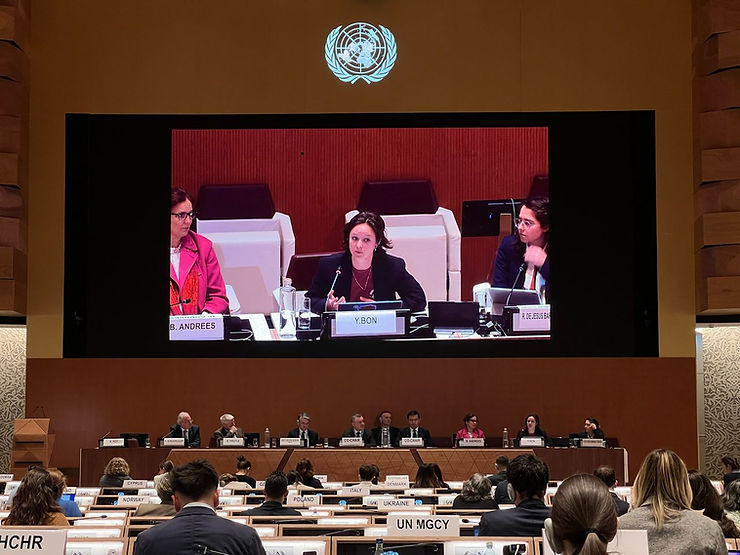
My name is Yara Bon from WO=MEN Dutch Gender Platform. Today, I am speaking on behalf of the Regional Civil Society Engagement Mechanism to share our closing statement.
Let me start with sharing about the challenging times before going into the challenge of each of the SDGs under review during this Forum. And the barriers there are for civil society and how Member States and the UN can support.
We are living through what many are now calling a time of polycrisis. From the post- COVID-19 pandemic, to the Russian invasion of Ukraine, to the climate catastrophe and the genocide in Palestine, to economic and energy crises — all of this is happening against the backdrop of rising authoritarianism, erosion of democracy, unprecedented funding cuts shrinking civic space for civil society, disinformation and pressure on fundamental rights and freedom of assembly.
In our region, feminist, LGBTI, and environmental movements have been hit the hardest.
And yet — we are still here. We are mobilising, we are building new coalitions, we are Holding the Line.
And that is what gives us hope.
It gives us hope that despite all odds, this Forum saw strong CSO participation. It gives us hope that Member States from our region are still pushing for progressive legislation. And yes — it gives us hope that this space, this Forum, still exists, and that we are speaking honestly and sharing our experiences.
It gives us hope that today, the European Court of Human Rights ruled to uphold the demonstration rights of the Extinction Rebellion and that the Human Rights Council adopted the resolution to begin the drafting of the convention for the rights of older persons.
It gives us hope that in these difficult times, we are not giving up on multilateralism. We are not giving up on each other.
We were reminded by the President of ECOSOC that climate change and gender inequality are not opinions. They are facts. And yet, too many governments treat them as optional debates.
What worries us most is the growing trend of transactional diplomacy — a diplomacy that turns away from accountability and towards the interests of oligarchs, non-democratic and fascist regimes.
We are alarmed by the state capture of institutions, the rise of Foreign Agent laws that muzzle civil society, and the weakening of legal avenues for redress and demonstrations. We were shocked to learn that Hungary will withdraw from the International Criminal Court.
Hope is still alive. We will not stay silent. Most of the rights we have today were not given — they were won.
Civil society is not a threat to democracy. We are proof it exists. You may burn the forest and pour concrete over the soil — but we will be the cracks where life returns.
On SDG 3:
We want to acknowledge progress made on universal health coverage and ageing. But critical voices are still missing — especially LGBTI communities, who face higher rates of suicide, homelessness, and discrimination in care systems. Migrants, who form the backbone of our care economy, are still stigmatised and too often left out.
We agree with the life-course approach to health — one that includes mental health, sexual and reproductive health and rights, digital literacy and access for older people, gender-sensitive and migrant-inclusive services, and equitable and affordable access to health professionals. Health is not a commodity. It is a human right.
A study published in 2025 found that the passage of anti-LGBTI resolutions increased total suicide attempts by 16.5% per 100,000 individuals, highlighting the severe mental health impact of discriminatory policies. Such impact is exacerbated by the lack of transgender healthcare. This data underscores what our communities already know — exclusion kills.
On SDG 5:
Feminist and LGBTI movements are on the frontlines of the fight for democracy. They are being criminalised, imprisoned, defunded. Even denied access to rights because of the binary interpretation of sexes.
Intersectionality remains a buzzword in this space — used often, but rarely applied.
We cannot talk about public participation and leadership without talking about the sticky floors — the structural barriers that keep migrant, racialised, LGBTI and working-class people from even entering the room.
We cannot talk about gender equality without naming the rise of white supremacy, climate denialism, and colonialism – something this region bears responsibility for.
While we welcome commitments to women and girls, we call on Member States to move beyond binary thinking. Gender-diverse people are systematically excluded from healthcare, housing, education, and data. This must end.
We demand inclusive language and intersectional data that reflects lived realities.
On SDG 8:
Let us be honest. This very institution does not pay its interns — a practice that contradicts the values of SDG 8 and limits who gets to be in these spaces.
Globally, 50% of people are without social protection and 60% are in informal employment. We call for the financing and implementation of universal social protection, in line with ILO Convention 102, and Recommendation 202. It is urgent to uphold existing and new international labour standards on platform work and demand investments in the care economy that ensure fair pay, decent work, and access to services.
Technology cannot be left unregulated. We must uphold human oversight in algorithmic decision-making, especially in workplaces. We must embed circular economy principles, ensure energy and sourcing transparency in digital infrastructure, and regulate tech companies to uphold rights.
On SDG 14:
If our oceans die, we die.
Oceans — if they were a country —their income generation would make it the fifth largest economy. Yet they receive the least funding of all SDGs. 80% of ocean pollution comes from plastics, and 90% of plastic is used only once. This is a crisis of waste, greed, and inaction. War is polluting our seas and water supplies.
We urge all Member States to ratify the High Seas Treaty and to develop a global treaty to cap plastic production and end plastic pollution. Ocean literacy is for everyone — including landlocked countries.
On SDG 17:
Multilateralism must mean inclusion.
Yet civil society continues to face exclusion — from shrinking civic space and restrictive visa regimes to inaccessible venues and the absence of sign language interpretation. The latter barriers are in direct violation of the CRPD and undermine the UN’s own Disability Inclusion Strategy.
Europe’s colonial countries bear the burden of climate change, and continue with business as usual – extraction from countries abroad to fuel our “green growth”. Growth is never green. It depends on invisibilized, racialised and feminised labour.
Let us be clear —without adequate, accessible, and redistributive financing, there will be no just transition, no climate justice, and no meaningful implementation of the SDGs. The tools exist — what is lacking is political will. We call on Member States to commit to progressive taxation, regulate extractive capital and private tech, and centre feminist, community-led, and rights-based solutions.
Care work, civic space, and climate justice must be treated as core priorities — not optional add-ons. The green transition must not deepen inequality. It must dismantle it.
In closing,
Civil society needs the UN, just as the UN needs civil society. We must not just survive these polycrises — we must transform them.
What gives us hope is that we are still here — organising, resisting, building, surviving. And not because it’s easy, but because it’s necessary.
Thank you.
18 Nov 2024 | Beijing Platform for Action, Interventions
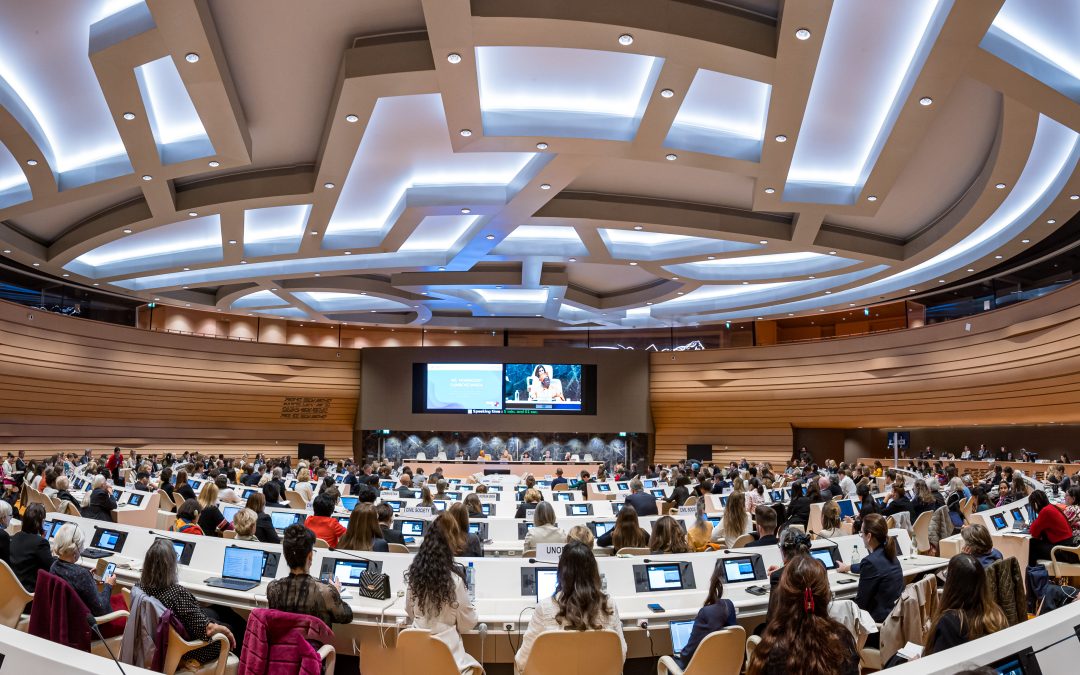
UNECE Regional Review Meeting on Beijing+30
21-22 Oct 2024, Geneva
Below text is a statement by ONWA and CRIAW which was written – but not delivered – for the session “Item 6: Women in leadership and their full and equal participation in decision-making in the ECE region“.. Learn more about the regional review here.
Thank you Chair.
Gagee Ge Be Kweg indigo, biizhew dodem, Kenora, On nindoonji
My name is Ingrid Green. I am here with the Ontario Native Women’s Association (ONWA) —the oldest and largest Indigenous women’s organization in Canada.
I am here amplifying the collective voices of almost 40 Indigenous women’s organizations and groups.
I would like to thank the Canadian Research Institute for the Advancement of Women (CRIAW) for supporting our participation – it is critical that Indigenous women’s voices are not silenced in this space, and that others do not speak for us. ONWA and CRIAW work together and are part of a larger network of organizations committed to implementing the Beijing Declaration.
Indigenous women have inherent leadership rights and have always been leaders in our families, communities, and nations.
While colonization and ongoing colonial practices and policies disrupted our leadership, our right to leadership is inherent and must be upheld.
“Women in leadership and decision making” is not just about holding political office – It is about upholding Indigenous women’s inherent leadership right and our right to be included in decision making on all issues that impact our lives, our families, and our communities. We hold the solutions to the issues we face.
Indigenous women must be included in decision making not just at a regional or State level but also within the United Nations.
It is our inherent right as life givers and water and land defenders to speak on our own behalf and represent ourselves, our families and our future generations.
This inherent right is affirmed under the United Nations Declaration on the Rights of Indigenous Peoples and the Convention on the Elimination of Discrimination Against Women, CEDAW General Recommendation No. 39.
We are concerned to see that the Beijing Declaration of Indigenous Women – drafted in 1995 by Indigenous women leaders from around the world who gathered at the Fourth World Conference on Women in Beijing – has not been included any discussion for this session.
The Beijing Declaration of Indigenous Women is a wholistic and comprehensive document that recognizes our relationship with and responsibilities to Mother Earth. It includes recommendations that uphold our inherent and collective rights to self-determination, to our territories, development, education, health, intellectual and culture. And, it provides specific recommendations that acknowledge that Indigenous women’s experiences of violence and discrimination, and the context in which it occurs, are different from that of non-Indigenous women.
Our experiences must be understood through the racism, sexism and discrimination we face both as women and as Indigenous peoples.
Excluding the voices of Indigenous women is a propagation of paternalistic and systemically racist and sexist tactics that have long contributed to Indigenous women’s marginalization and silencing.
Without engagement with, and solutions led by and for Indigenous women, we will continue to have our safety compromised, experience disproportionate involvement with the child welfare system and overrepresentation in the justice system, and have our social determinants of health impacted.
The failure to adopt an approach to leadership and decision making that is inclusive of Indigenous women is a fundamental barrier to the advancement of human rights in the UNECE region and around the world.
Indigenous women’s inherent right to participate in decision making on all issues that impact our lives must be upheld.
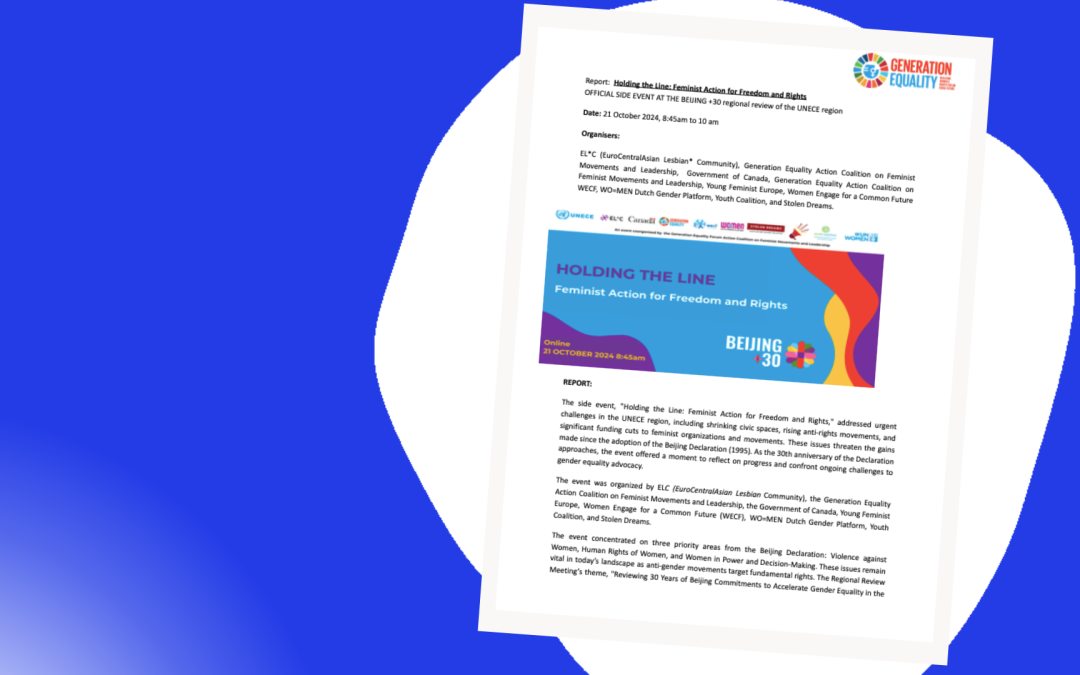
31 Oct 2024 | Beijing Platform for Action, Our events
Geneva, UNECE Beijing+30 Regional Review
As we mark 30 years since the adoption of the Beijing Declaration and Platform for Action, feminist movements in the UNECE region are confronting a sobering reality: the same rights we’ve fought for over decades are under threat once again.
At the Beijing+30 Regional Review in Geneva, the Holding the Line: Feminist Action for Freedom and Rights side event created a space to name these threats—and organise against them. With civil society under siege, funding slashed, and anti-rights actors emboldened, the message was clear: we cannot and will not cede ground. We are holding the line, together.
A tale of two realities
Opening the event, Emilia Saiz (Co-Chair, Generation Equality Action Coalition on Feminist Movements and Leadership) described our political moment as a “tale of two cities.” In one, feminist wins are celebrated. In the other, rights are rolled back, civic space is shrinking, and backlash has gone mainstream. The feminist movement, she insisted, must build intersectional, community-rooted partnerships to resist these tides. “Our agenda is for everyone,” she affirmed.
Grounded in lived realities
Through vivid testimonies, speakers highlighted the resilience and resistance of feminists organising in the most repressive contexts—from Turkey and Georgia to Gaza, Canada, and Central Asia. The session centred three of Beijing’s critical areas:
- Human rights of women and girls in all their diversity
- Violence against women and girls
- Women and girls in power and decision-making
Each panelist brought the conversation back to the people and movements most impacted by anti-gender violence and authoritarian politics.
Vera Rodriguez (European Sex Workers Rights Alliance) challenged us to see sex workers’ rights as feminist rights, calling out the violence of punitive laws masquerading as protection.
İlayda Eskitaşçıoğlu, a Turkish menstrual justice activist, called for bold youth participation, while amplifying the resilience of movements organising under siege.
Aïda Yancy (EL*C) spotlighted lesbophobic violence and state erasure—reminding us that visibility can mean vulnerability, especially for queer women and non-binary people.
Joy Namulondo (Youth Coalition for SRHR) spoke of rising right-wing influence in Canada and the ableist exclusions baked into policy debates.
Ana Muradashvili (WECF Georgia) brought powerful testimony from a country where hard-won gender quotas were recently repealed. Her call was unequivocal: we must rebuild feminist leadership from the ground up.
Building power across borders
The session didn’t just diagnose problems — it offered strategies. In a rich dialogue, participants shared stories of solidarity, cross-regional resistance, and sustained movement building.
One core message rang loud and clear: intersectional feminist organising is the most effective antidote to authoritarianism. Whether in Western Europe or Central Asia, we must be willing to step into discomfort, challenge extractivist economies, and resist militarised governance. We must move beyond symbolic inclusion and commit to deep, shared ownership of our collective feminist futures.
Key calls to action
The session concluded with strong, unapologetic recommendations:
- Fund feminist movements — fully and flexibly. Core, long-term, accessible funding is non-negotiable.
- Make intersectionality real. Sex workers, trans people, Indigenous women, people with disabilities, migrants, and rural communities must be at the heart of decision-making.
- Break the silence on migration and border violence. Feminist agendas must integrate racial and gender justice at the border.
- Move beyond symbolic partnerships. Real change demands co-creation with feminist civil society — not consultation, but collaboration.
- Confront the anti-rights backlash head-on. This means confronting not only far-right ideologies but the systems — capitalism, colonialism, militarism — that uphold them.
This is not the end
As Bruna Martinez (Young Feminist Europe) and Jeevika Shiv (UN Women) reminded us: this was not a one-off conversation. Holding the Line is an ongoing practice—a political, strategic, and emotional commitment to stand together when the winds turn against us.
Our movements are being tested. But our solidarity is stronger. As feminists across generations, geographies, and identities, we will continue to hold the line—and push it forward.
We are not giving up. We are not giving in. We are holding the line—together.